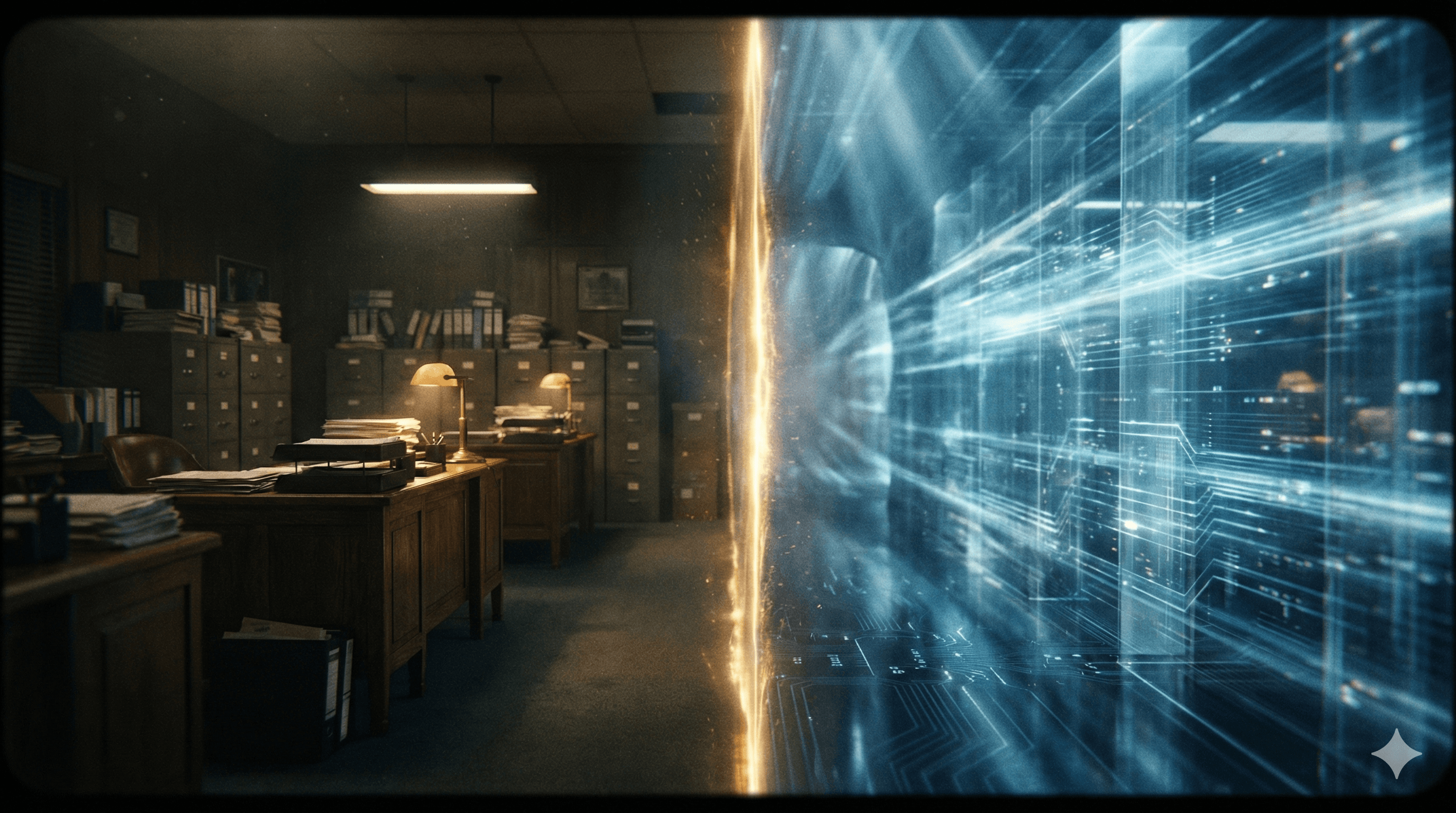
Every piece of information you work with lives in one of two places. The human world, or the AI world.
The human world is where most professionals still operate. PDFs. Email threads. Slide decks with carefully formatted layouts. Documents designed to be read by people, shared in meetings, printed on paper. This is the world that runs at human speed. One person reads, one person writes, one person reviews. It works. It's also 1x productivity, by definition.
The AI world is different. Information there lives in formats that AI can ingest, manipulate, and transform at machine speed. Plain text. Structured data. Formats that AI reads natively. When your information is in the AI world, everything I've described in this series becomes possible. The research, the orchestration, the 80%-in-two-hours workflow. That's the 10x layer.
Most people don't know the AI world exists. They interact with AI through a chat window, asking it questions and getting answers. They've never considered that there's a whole operating layer on the other side where information moves at a fundamentally different speed. Until you recognise that this second world exists, and that you can move your work into it, you're locked at 1x.
And right now, roughly 80% of enterprise information is locked in unstructured formats. PDFs, emails, presentations, documents. Four-fifths of what most organisations know is stuck in the human world, unable to move at AI speed. That's the friction, measured.
Here's what the boundary looks like in practice.
Last month, a client handed me a stack of capability presentations. Polished slides. Beautifully designed. Completely useless to an AI in that form. A presentation is built for a human audience. The information is embedded in layouts, scattered across slides, buried in visual hierarchy.
So the first thing I did was have AI convert those presentations into markdown. If you haven't come across it, markdown is just stripped-back text with simple formatting. Think of it as the native language AI thinks in. And the conversion wasn't just extracting the text, but visually interpreting the slides. Graphs, diagrams, visual representations of data. The current models are remarkably good at understanding what a chart is communicating and capturing the substance of it in a format they can work with. The beautifully designed deck became raw material.
Once that content was in the AI world, I could combine it with other materials, feed it into research workflows, and produce new outputs at AI speed. The same information, liberated from its human-world packaging, suddenly had velocity.
The strategic move is to reduce the boundary crossings. Migrate the core of your working process into the AI world and keep it there for as long as possible. Do your thinking, structuring, drafting, and iterating in AI-native formats. Only cross back into the human world at the end, when you need a polished deck or a formatted report for a human audience.
Most people do the opposite. They work in human-world formats, then try to get AI to help, then translate the output back into human-world formats. Every crossing costs time and effort. Do enough crossings and AI genuinely feels like overhead rather than acceleration. That's not because AI doesn't work. It's because the work is happening on the wrong side of the boundary.
Here's what makes this interesting. The boundary between these two worlds isn't fixed. It's moving. Fast. And it's being compressed from both sides.
From one side, the models are getting better. Six months ago, handing a messy PDF to an AI meant significant friction. Today, the latest models can read complex documents, interpret tables, parse layouts, and extract meaning with dramatically less loss. Every model upgrade pushes the boundary, making it easier to bring human-world information across without manual conversion. OpenAI alone releases a new capability roughly every three days. The boundary you mapped last month is already out of date.
From the other side, your expertise pushes it too. The more you work with AI, the more instinctively you structure information for AI speed. You start keeping things in formats that AI can work with until the very last mile. The friction zone narrows. The 10x layer expands.
But there's a subtler skill underneath all of this, and it might be the most important one.
Knowing where the boundary is right now.
The boundary moved last month. It moved again this month. Something that required manual human effort eight weeks ago might now be something an AI handles cleanly. The person who periodically tests whether a task has crossed from the human world into the AI world is the one who keeps accelerating. The person who assumes the boundary is where it was six months ago is leaving speed on the table every single day.
This is the meta-skill. Not just operating in both worlds, but maintaining an accurate, current map of where one ends and the other begins. The map is being redrawn constantly. The people who update it fastest have a compounding advantage over those who don't.
Start noticing where your information lives. Start asking whether it needs to be in human-world formats, or whether it could be working harder for you in the AI world. Start checking whether something you've always done manually has quietly crossed the boundary.
That's where the next multiplication comes from.
Your move, human.
Damien Healy is the founder of Qanara, an Australian AI consultancy helping businesses accelerate from strategy to impact. He writes about AI-native workflows, frontier AI capabilities, and practical transformation.